Have you ever wondered why Google won the search wars? Kind of important when you think about it, not just as a technology based success story, but now with larger economic implications. Google started as a PhD research thesis by Larry Page and Sergey Brin in 1996. By 1998 they felt they could make a go of it and so incorporated (still just the two of them) on September 7, 1998. Right from the beginning the Google search website enjoyed much success.
In August, 2004 Google launched its IPO, and sold off 19 million shares at a starting price of $84. At the time the IPO would raise 1.67 billion US dollars and the stock represented a total market cap of around $23 billion.
Fast forward to today and you will find that Google, the publicly held corporation, is listed as the “largest American company by market capitalization not listed in the Dow Jones as of October 31, 2007″¹. The parent company has over 16,000 employees and keeps massive search engine server farms at 25 locations across the globe.
And that initial share price of $84, the one that Wall Street scoffed at? Over the last year Google shares fluctuated between $437 and $747 and the current market cap is at $159 billion.
The company is a monster. So how did it happen?
Reason Number one: It just worked
Way back when, finding things on the Internet was hit and miss. The early search engines were slow and tended to produce questionable results. Early exploits of search engines included stuffing page headers with search terms, or hiding search strings in background images. These tactics worked at the time because the search algorithms would rank pages found based on the number of occurrences of the search term. Page and Brin thought they could do better. They devised an algorithm based on the number of links to the target. They correctly theorized that the importance of a page of information is mostly dependent on how many other pages point to it.
This simple, yet powerful algorithm had a built in equalizer. In order to show up in the top ten of the Google results, your page has to be linked by many other pages, pages that are not necessarily controlled by you, the web developer. Google took the control of the relative importance of a web page out of the hands of the web developers and placed it squarely into the hands of the internet community. As popularity of your site increases, so does the ranking of your page in the Google search results.
Of course there is a lot more to Google’s stunning success story than the search algorithm — the large scale distributed underlying architecture for one. In 2006 by some estimates Google had amassed 450,000 servers that sit in large installations and are connected by a grid². The distributed nature of the solution is truly global, with data centres in Ireland, Virginia, and California, with the newest one being constructed in Dalles, Oregon. The Google approach is to connect large numbers of small scale servers and allow them to perform parallel computing, something the geeks call “clustering” and “symetric multi-processing”. Whatever the geeks call it, the general internet audience is the big winner, because Google searches are always blazing fast
So Google had two great characteristics in its original online search engine, accuracy and timely responses. These two features combined are enough to make anyone a repeat customer, especially if you compare them to the search engines of the day. And circa 1998 there wasn’t much else to choose from. Google’s astounding rise to dominance is well known. Accuracy and timely responses certainly form the inner core of the search engine. But there is another aspect, one that I believe is often overlooked and contributed greatly to Google’s success; the user interface.
Reason Number two: What you want is what you get
Here is a screenshot of the very first Google search page, from 1998.
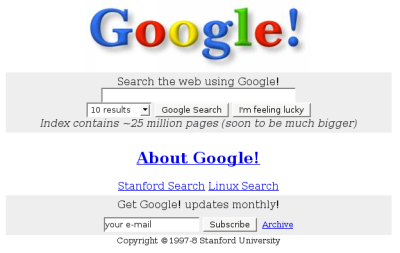
And here is today’s version. Notice something? They are almost exactly the same. The designers of this user experience had something very specific in mind. Clear the clutter. Provide no more than 10 results on any returned page. No flashing images. No add banners. No navigation labyrinths in which to get lost. Just the results, and a way to go directly to each one.

The Google interface design recognizes basic human needs and delivers. When you go to Google you need one place to enter some phrase or keyword. So the Google search page has one field in the centre of the page. No hunting around for a place to enter something, no forced login, no tabbed interface, no maze of menu choices.
Most importantly the Google search page and the pages of results are careful not to prominently display any third party adverts. If advertised links are displayed they are subdued and shown simply as a link, but carefully separated from the ‘official’ Google results. This provides the user with some visual assurance that Google isn’t messing with the results and sneaking in links that are nothing but clandestine commercial marketing pages.
The psychology of the Google interface is most interesting. I think the underlying message is one of virtue and objectivity. By maintaining their disassociation with any third party vendor, Google has its users believing they are getting the most objective search results possible. The Google interface design could be summed up as “what you want is what you get”.
The Google search page — the first page that any user of the search engine would see — hasn’t changed appreciably since it was first rolled out in October of 1998. And so it was for the ten years that Google grew from a Phd research paper into one the world’s largest and dominating influence of information technology.
Bottom line
Most of the chatter today in the media is about what Google will do next. Why are they buying up rights to a chunk of the cell phone spectrum? What is their latest strategy for capturing the Desktop market? Do they really think they can overtake hotmail as the most popular free email service?
But Google has the financial clout to undertake these endeavors because its gigantic revenues are fueled by the search engine service. And their search service continues to dominate, some estimates show that Google searches top their nearest competitor by more than a factor of two. And Google hasn’t changed the search interface formula since it was first introduced. What they did invest in over the years was making the underlying engine scalable, and continue to tweak and improve the algorithm that does the real work of obtaining search results.
The basic design paradigm is to put the complexity and intelligence of software behind the interface, and leave it there. A complicated user interface is usually nothing but a frustrating and fruitless experience for users. Google users around the globe vote with their searches. Google marketing clients around the globe recognize this, and vote with their dollars.
References
- Google’s Surge Would Make Casey Kasem Proud, Wall Street Journal (October 31, 2007)
- How Google Works, Baseline (July 6, 2006)
Tags: algorithm, design, Google, search, user interface