Protected: Chapter Two
March 10th, 2020Flip Phone Challenge: Day 30
October 5th, 2019
You can’t believe how much potential each and everyone has. You see that it was given to them before they were born, in fact they’ve had it all their lives, the lives they have lived, and the lives they are yet to live, although it feels like they don’t have it all sometimes. The greatest tragedy, and it plays itself out each and everyday, for all of them, is that the potential just sits there, like some beautiful flower that is only a bud, all of that beauty hidden away from your eyes, its there but no one sees it, and therefore it might as well not exist. What is something until someone sees it, feels it, smells it? Its nothing at all.
As an alien here on earth you breeze past hundreds, some days thousands of souls that are just that – beautiful creatures that are unseen, unheard, unfelt. This observe and report gig has turned out to be a goddamn tragedy and you will be damned if you put pen to paper and submit it to the powers that be.
You realize they have had a tough go at it, to be sure. You remember the early religions made a splash a couple of thousand years ago, but the true message was lost in translation. That funny carpenter dude wandering around the Jordan river was just too much for everyone to handle, and so his message was subverted and the whole damn thing was hijacked in order to leverage power and suppression. They swapped out love for fear, and the rest is history. Pretty much the exact opposite of what dude intended, a crying shame. The only one who wrote anything of use turned out to be Didymos Judas Thomas, and he got lost in the desert and it was all buried deep in the Egyptian sand, the ever changing sands of time.
By the time some nomads dug it up in 1945 in Nag Hammadi everyone was out for themselves and the world was weary of all the killing. Besides the nomads being illiterate, the scripture was also written in Greek. They simply didn’t have a clue what they had found. Firewood is scarce in the Sahara, so all that survived from the 13 volumes was a few parchments. Yup, you think, that was a crazy bad start.
Except of course until that last great bright spot in the ’60s. Some hippies with flowers in their hair in Berkeley decided that the path laid out in front of them was not the way to go, and so they flipped a giant Fuck You at the crazy old white men in charge, who were still slapping themselves on the back for all the killing they did in Europe in the 40s. You remember there were moments of courage, like Woodstock, and moments of death like the four in Ohio.
You’ve seen a lot planets in your time, a lot of lifeforms, all of them different and some, like your own ancestors knock it right out of the park. And you’ve also seen a lot of trainwrecks too. With these mind control devices replacing the old religious ways you realize things have taken a sudden, technological turn for the worse. You figure that you just never know how its going to turn out.
You notice that Day 30 of your mission is up. You know you have to write this damn report.
You start.. you begin by writing that …
.. they’ve got global warming cranking up the thermostat in this house, and meanwhile there are literally billions upon billions of lost souls wandering around completely bamboozled by these mind control devices, there really is no other term for it. These creatures, these earthlings, and their greatest assets – creativity, curiosity, community, warmth from connecting with one another, are all slowly dulled down by the capitalist surveillance warlords, who would like nothing more than to turn everyone into billions of programmable consumers, buying the things that they have been nudged towards.
You glance at the bottom of the report. You have filled a lot of these out before. You don’t have to read it. You know it says:
Check one.
 a. Make contact
 b. Re-assess later
 c. Ignore
 d. Vapourize
Something stirs inside of you. You think of all that lost potential in these earthlings. So much potential lying dormant in each and every one of them. The earthling host you chose 30 days ago in Edmonton has been brushing past a lot of people lately, travelling to Toronto on business, he likes to get lost in the masses of people. Uses the subway, and walks the streets at night. He’s different from most of the humans you encounter. They won’t go anywhere without summoning Uber. You notice he has no fear, no agenda. Then you remember. He’s using a flip phone. A flip phone!
Your thoughts return to your mission. There are strict rules from deviating. The mothership will soon contact you. Once your report is submitted the tracking beam will teleport you up, and you will be blasting back home. Another planet, another day.
“What if…what if I just destroy the tracking device. What if I stayed inside this host. What if I broke the prime directive, which is to never, never, make unauthorized contact, or to influence the native lifeforms in any way whatsoever..” You are suddenly struck with an idea, you think that this is a defining moment. What you decide to do next cannot be undone. Your heart races. Your breath quickens. Slowly but surely you reach over to the tracking device. Such a small silver disc like object, that has a soft red glow in the centre, yet so powerful. If you just change channels on the earthling host you are in for a few seconds, you can make your way to the LRT tracks that are nearby. You could place the device carefully on the track. The heavy trains that roll by every now and then would easily take care of the job.
You look down intently on that smooth silver disk, now sitting in the palm of your hand. You think of the humanity you have been studying.. and all of the wonderful possibilities they posses. And then you think of yourself.
“What possibilities lie… in me?”

30 days ago I agreed to enter the Flip Phone Challenge. The mission was easy to state. Turn over your personal smart phone and have it locked with a pin unknown to you. Then replace it with a Flip Phone. Manage your affairs accordingly.
Those 30 days are over. What did I discover? That time is my biggest asset. And what did I realize? That I was able to win back part of my life. A big part.
Flip Phone Challenge: Day 23
October 1st, 2019
[Editor’s note: Day 23 proceeding Day 1, and Day 9]
Its hard being an alien stuck inside this human body on earth. You see all kinds of nature here, trees, leaves, green grass. Beautiful glassy blue crystal clear mountain streams, with the water softly falling down, so cold and clear. Giant groves of majestic poplar trees, the leaves flicking against each other in the light summer breeze. Tall grassy fields that sweep on endlessly until they give way to a grove of bulrushes, and a dark deep blue pond. You hear some ducks quacking in the distance, a mother herding her ducklings in the sunshine, forming a row, ever mindful of her brood.
The forests are teeming with life, large stands of birch, tamarack, and spruce trees. Thousands of species of birds everywhere. Very early in the morning by a huge sweeping lakeside shoreline you hear them. Bluebirds, goldfinches, orioles, sparrows, robins, all of them singing together in a mind blowing symphony, early in the morning as the sun rises to greet the day.

The humans are mostly divorced from this. They climb into their vehicles early in the morning and whiz off to their day jobs. As you take your notes for this ‘observe and report’ mission you enter that
“..their actions although unique to their individual circumstance have a common element. They have to have that black rectangular device with them before they leave the house. They check it while sipping coffee. They check it after brushing their teeth. They glance at it quickly before leaving for the office. And lo and behold they check it when they get to the office.”
On these black devices there is messaging. Dozens of messages for most, for some hundreds every day. Some humans are flipping back and forth between 5 or 6 conversations at a time. The younger ones are texting so fast, and flipping between conversations that they often cross wire their messages by mistake. As well as mainstream messaging humans are winging WhatsApp, Messenger, and WeChat missives.
Then there are the mindsucking apps. These insidious things claw onto the human consciousness with a remarkably tenacious grip. And they don’t let go. FaceBook the app, Instagram the app, Twitter the app, SnapChat the app, Pinterest the app, linkedin the app..
Meanwhile any free time that might have evaded the mindsucking apps is quickly consumed by a bevy of time idling apps, Things like the youtube, netflix and reddit, with their notifications showing up here and there, gently reminding that there is something new to be looked at.
The human mindspace has become a kind of a battlefield, the big four deploying new apps designed to grab attention and hold on to it at all costs. The design put into them is about claiming the largest share of attention. Tapping into the human psyche, they exploit the intricate workings of the human brain.
You are reminded this observe and report mission has thirty days on planet Earth, you’ve seven more to go. But you see a trajectory here, you see a pattern. Human intimacy, face to face conversations, humans experiencing connecting with one another is vanishing, replaced by a thin veil of existence. Digital existence.
Seven days, seven days. It’s going to be a long seven days.
The Flip Phone Challenge: Day Nine
June 13th, 2019
Imagine you are an alien being, on assignment to check out the inhabitants of planet Earth, trillions of miles from your home planet. You get the details, and realize the journey will take 72 hours because you have been booked on a clunky old intergalactic spacecraft that can manage a measly 2.5 times the speed of light. This pisses you off.
Your mission: Arrive on planet Earth and use your shape shifting ability to assume the human life form. The data sheet you were given reads ‘human’ with a footnote that states they have been chosen because they appear to be the most destructive, and dominant life form on Earth. It was a toss up between humans, cockroaches or diatomaceous single celled sea creatures simply based on the planet life form counts, however the last data collection point for lifeforms was 1954, when the Roswell Mission went horribly wrong, After that trips to planet Earth were limited until the ‘dust settled’.
“Speaking of dust..”, the document continued “..please do not assume the standard Ziggy Stardust identity..”. Meticulously designed to ‘blend in’ to populations found on planets in the Milky Way, the results were less than satisfactory, and in fact resulted in world-wide notoriety, three platinum records, and a motion picture in 1973.
Your mission is to assimilate into the population, avoid detection, and observe and report the activities and habits of these creatures. Then get on the carrier and head home. Sweet, sweet home. These intergalactic gigs are killing you.
The spaceship is parked on the dark side of the moon (standard for this type of activity) and you head to Earth. You decide to go for some friendly uncle persona. You use the shape shifting device and select the Earth:human setting. You see a friendly avuncular looking poor sod standing on the LRT platform. You are in the remote and sleepy population congregation area of Edmonton. Roughly on the west side of the great plains that roll up like a carpet to the spectacular mountain range that runs down the length of the North American landmass. “This guy looks ok”, you think. He seems different from the rest of these humanoids. The other life forms are strangely distracted.
“I actually don’t mind taking the life form of these disgusting human creatures,” you think, “but I’ll be damned if I choose something that’s half asleep.”
You board the next train, politely shuffling your feet and avoiding eye contact. ‘When in Rome..’ you remember from the training manual. As you stand on the train, and it winds its way through the city, underground, then out again to cross a river you begin to notice something. There is no need to avoid eye contact. There is no eye contact. Everyone’s eyes are glued to these black, rectangular slabs of plastic, or perhaps metal. Most of the people on the train in fact. It continues underground for several kilometres. You are impressed by the intentness of these humans. They are consumed by these devices. There really is nothing to observe. No interactions, no talking, no laughing, no sharing. These creatures are wedged onto the commuter train, close quarters, but they are not interacting. All of their activity and attention is on these black slabs. There must be something amazing, something incredible there. Those things seem to have overridden everything else that presents itself in life. Almost as if life itself is inside these black slabs.
Further investigation is warranted. Such an overwhelming influence. Perhaps they had found a device to connect everyone, to work to a common goal.
You are an alien. You do not speculate on human culture, instead you use the power of observation. Like a good scientist, these observations are sent back to the mothership. From there it is relayed to the home planet, where, a group of your fellow scientists will form new hypotheses about what the planet Earth and its inhabitants are up to.
You recall from the past when Earth’s humanity faced insurmountable odds, often existential crises. But what had happened was most curious. It motivated tremendous ingenuity. Such as the concept of divide and conquer, where a large problem is split in smaller manageable parts. Each part is solved by a single individual, then the result passed on to the next individual who had their problem to be solved, proceeding thusly, and so on, and so on. Eventually the entire group had participated in the final solution. That was brilliant work done by the human race.
You think of Bletchley Park, when teams of mathematicians and Alan Touring cracked the Enigma cipher.
Or NASA in 1963 when the human computer project solved the landing trajectories and orbits of the Apollo missions.
Or, on a darker note the Manhattan Project, where teams of mostly women were assembled to calculate the pertinent details surrounding the fusion of the atomic bomb, whose results were used to execute the most horrific act of warfare ever.
Perhaps a world-wide initiative to solve some impending doomsday scenario that they are all facing? You recall the fear that was felt – the threat of Nazism inspiring Alan Turing and company, and Oppenheimer with his dastardly device, or the J. F. Kennedy inspired teams that propelled the USA to win the space race.
These humans can be motivated to achieve great things. Your mind races ahead. “I must gather this data, I must see what they are up to this time.”
So you sally forth with an idea of sneaking a look at these enthralling handheld black slabs. If you can get a peak of the screens. See what calculations, what possibilities are revealed…
The Flip Phone Challenge: Day one
June 3rd, 2019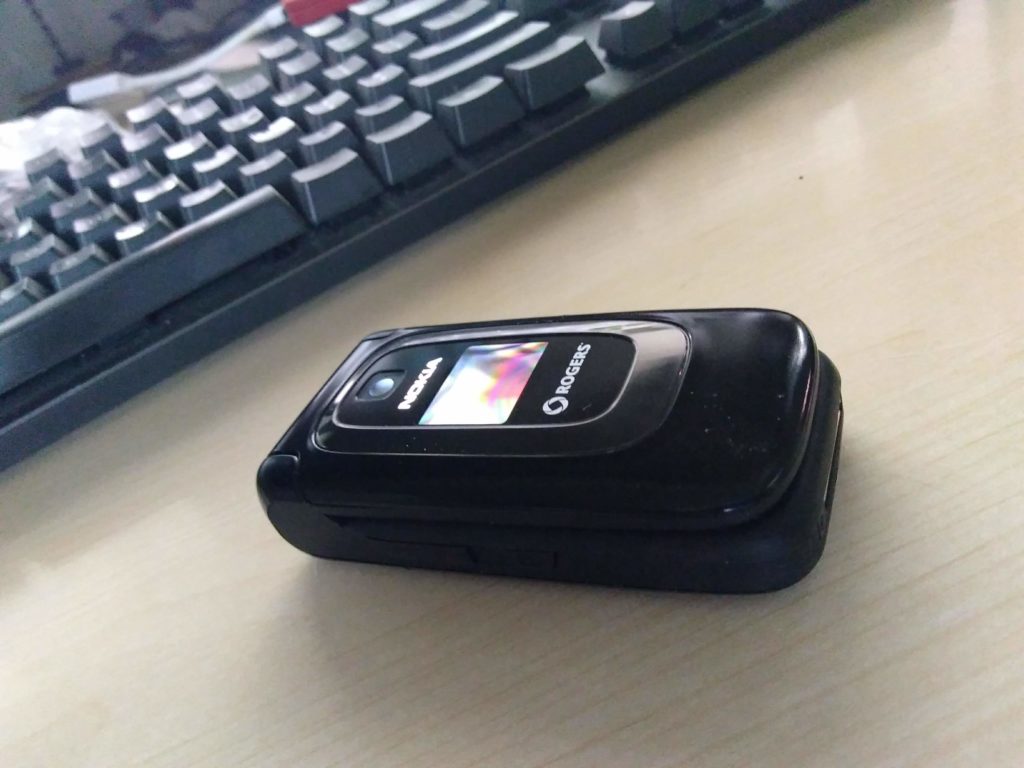
Recently a co-worker announced she was leaving the company. Not just any co-worker, mind you, one who toiled long before most of the people in the office had started. The kind of employee who knew everything. Where everything is, what the rules are, who to contact, and so on. The type who related stories about when the company actually started, “employee number 12”, that sort of thing.
She emerged from her cubicle, hidden deep into the dark recesses of the office, from where only the bravest ventured. She had been cleaning out her desk. Finding things of value that had long since been squirreled away. Things long forgotten. She approached my desk, a wry smile on her face. “Here” she said, holding out a vaguely familiar box that looked like something from a distant dream, that spoke of earlier times, when there were possibilities, not just probabilities that had already played out.
Inside the box was a Nokia 6085. There was a manufacturing date on the box that read 2007. This was a pre-smart phone phone. This is what the masses were using just prior to the release of the iconic iPhone 3. It was state of the art in 2007. In 2019 holding this phone felt strange, laughable, improbable.
It had hardly been used, all of the packaging intact, plastic still covering the cables and connectors. It felt strange to hold it, to open it, to boot it up. A tiny colour screen showed games, an address book, a messaging app. Upon looking around one thing became apparent. No browser.
No browser.
The contrast between this phone and the phone the average person carries around today is stunning. There is no question about the utility of today’s modern smartphone. The pioneers of the cell phone industry were creating something that no one can deny would alter the very fabric of society. Cell phones emerged as clunky, giant suitcase boxes in the ’80s, with a standard phone handset and usually the curly phone cord attached. That quickly evolved to become smaller, more convenient, more useful. But the introduction of the smartphone catapulted the venerable cell phone into the stratosphere.
The smartphone operating system gave developers basically the same platform, more or less, on which to develop applications, as they have with a computer. The same applications that would run on your computer. Nowadays you carry a computer in your pocket. And there are literally billions of dollars spent on the software that runs on that computer.
For me I happily bought in to the smart phone concept, “this is great!” I told myself. Forking over hundreds of dollars every couple of years to get the latest hottest new phone. But slowly and surely a dark, sinister feeling came to inhabit my mind. The first clue was the ubiquity of the smart phone, easily witnessed during my daily commute on the train. I stopped counting the number of people glued to their screens versus the people who weren’t. Many people on the morning train nodding off to sleep, ever clutching their phones in front of them.
Next I realized I was checking my mail, and text messages way too many times during the day. Place my phone down on my desk, not too far out of reach so I could see that delicious message notification blinking light. “What’s that a new test message, pour moi?”. Several years ago I realized I was much more productive, focussed, and, well happier if I simply turned message notifications off. I realized that I did not want to allow my phone to interrupt me for, well, anything.
Sitting there in the office holding this dinosaur of a cell phone, yet in perfect condition, hardly used gave me an idea. Why not use this cell phone. Put my smartphone away. See how that can change my life. See what value the smartphone brings to my life – by taking it away.
And so my co-workers were quick to pipe up, “Say what! You won’t last a week!”. Well it wasn’t long before the Flip Phone Challenge was born. I must use the Nokia 6085 for 30 days. My phone will be locked by a duly appointed adjudicator, the pin only known by him. My smart phone will be inaccessible to me and I must sally forth into the world with, gasp, 2007 tech.
Today is day one. Heaven help me.
Introduction
March 17th, 2019One of the great advancements in the art of programming occurred when the concepts embodied by object oriented programming made its debut. The consensus is that the object programming style garnered legitimacy by appearing in Byte Magazine. The language was called Smalltalk. The year was 1981.
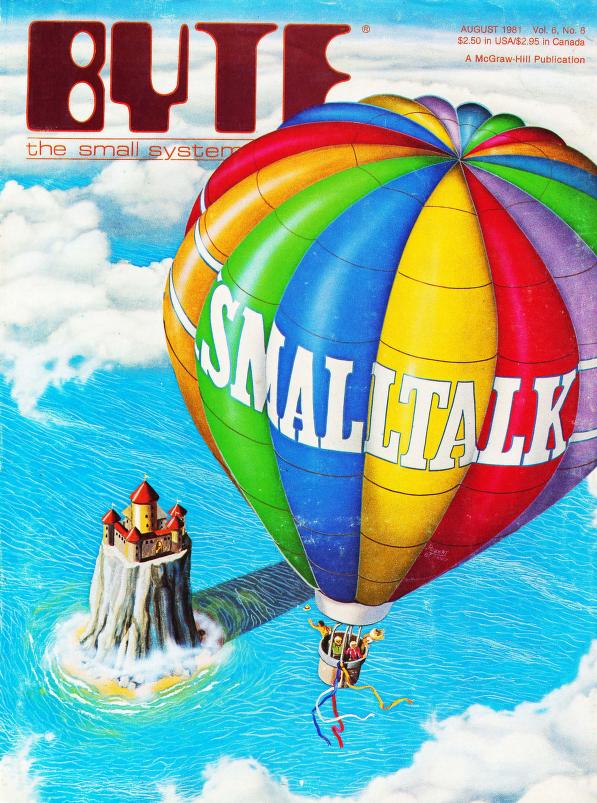
Object oriented programming, or OO as it is referred to by legions of beloved brethren to this day represented a seismic shift in the programming universe as it appeared in 1981. That was 38 years ago. Prince Charles and Lady Diana were on their honeymoon, and Micheal Jackson’s Thriller was only a concept.
Slow to catch on, mis-understand by the programming masses, and the believers (those who understood the implication) were simply shunned by the traditionalists at that time. OO was different because it enabled the programmer to introduce objects into the code, and objects are meant to represent something. That something could be real world things, houses, cars, trees, rocks, bank accounts, milkshakes and so on. Objects are connected to other objects, objects influence other objects. Objects pass messages back and forth, and some objects bend other objects to do their bidding. Suddenly the programmer was now lord and creator of a model of life; it gave her purpose and motivation. Programming was no longer a series of instructions to the cold, hard machine to move this bit over to that register, add the contents, and carry on with arcane machine instructions. OO was revolutionary in 1981. But the industry was sleeping, mesmerized by the sheer potentiality of what it was to become.
Protected: Chapter one
November 11th, 2018Dell XPS 13 broken wireless solved
January 26th, 2013Update: January 16, 2015. This problem persists, even by judiciously following the instructions below. The newest solution I have is to install Linux Mint. Which I did. And the wireless is now working for the first time since I purchased the laptop a few years ago. The great sputnik project is officially dead. Long live Linux Mint!
Read the rest of this entry »
The State of the Linux Graphics Stack
March 23rd, 2011Author’s note: This is the unedited version of an article that appeared on the Ars Technica website “The Linux Graphics Stack from X to Wayland” on March 21, 2011. See references at the bottom of this article for the link.
In 1984 the presidential election of the United States of America resulted in the incumbent, Ronald Reagan winning by the second biggest landslide in history. President Reagan captured 49 of 50 states, and nearly got the 50th, but challenger Walter Mondale won his home state of Minnesota by a mere 3761 votes. President Reagan’s victory was not a surprise to Republicans or Democrats, because it was his fiscal policy that had delivered the United States from the deep recession of 1981 and 82. President Reagan won in 1984 because he had already achieved what the American people wanted. Reagan won on the merit of what he had accomplished.
Read the rest of this entry »
The non geek’s guide to geek speak
November 13th, 2010Lately I’ve been thinking about what it would be like to listen to geeks have a conversation. It must be maddening, I mean when you think about it, because they live in a world of deep introspection, and the language is all their own. Although words and phrases are used that sound familiar, the meaning is all distorted.
I have been collecting a few uncommon or borrowed computer phrases that I come across day to day. Let’s call this post a guide to help non geeks understand geeks when they speak. Read the rest of this entry »